AI video creative that restarted growth.
After two years of testing, catalog ads still set the ceiling for this phone-accessory retailer. In-house AI video production opened up more tests. June revenue finished 22% above forecast; July revenue grew 21% compared with July 2025.
Each month’s forecast = 100 · axis starts at zero
Source: client CRM revenue · Prophet and a regression model
For two years, dynamic catalog ads were the account’s strongest performers. Changes to targeting, product feeds, and optimization brought no sustained growth. We changed the production process: instead of waiting for each creator to deliver a video, we started producing video ads in-house with AI.
In the Czech market alone we put more than forty new ads live in June. Revenue finished 22% above what the models expected, July added 21% year over year — and some of the featured products sold out.
Affordable phone accessories across five markets
Tvrzenaskla.eu sells tempered glass and phone accessories — screen protectors, cases, car adapters. Alongside reselling other brands it is building its own higher-margin label. From a Czech store it grew into a business serving several European markets, where it trades as Momanio.
We have run Meta for them for two years across five markets: the Czech Republic, Slovakia, Hungary, Greece, and now Romania. Important context: on this project Meta is not the main performance channel — Google Ads is. Which means Meta is held to a stricter standard. A channel that does not carry the core of revenue has to justify its budget, so we worked on attribution from the start, to know what Meta actually brings in and what it merely claims.
Otherwise it is a textbook ecommerce product: low price, fast decision, nobody spends a week thinking about a screen protector. Exactly the kind of range Meta suits — and exactly the kind where, for two years, the most boring ad imaginable kept winning.
Catalog ads performed reliably, but growth stalled
From the start of the engagement the catalog carried performance: dynamic ads that assemble products from the feed based on what someone browsed. The format was simple and consistently delivered sales. Some of those dynamic sets have run without interruption since day one.
That is good news and a trap at once. Good news because performance is steady and predictable. A trap because any thinking about growth logically starts with: “Dynamic works — so how do we make it better?”
And that is where we spent long months.
Two years of nonstop testing
Over two years the account went through dozens of tests — audiences, optimization events, campaign structure consolidation, flexible formats with several creatives in one ad, incremental attribution measurement, creative. Some of it became permanent: value optimization still carries the account’s best-performing dynamic set, a consolidated structure gives the algorithm room, and incrementality keeps us honest about what Meta really contributes. Some of it did not. Three of the larger hypotheses, all of which sounded excellent on paper:
Product sets
We carved subsets out of the catalog — bestsellers on their own, higher-margin own-brand products on their own. The logic: a higher margin tolerates a higher cost per acquisition, so a pricier conversion still pays. The algorithm saw it differently. A narrowed catalog gave it less room, and no set ever beat dynamic ads running across the whole feed.
Improving the feed
We reworked how product images looked in the feed so dynamic ads would stand out in placement. Visually better, identical in the results.
Optimizing for add to cart
The theory sounded right: there are more carts than purchases, more data means cheaper and steadier optimization, and the purchases would land through other channels anyway. On an impulse product it did not hold. Cheaper carts never turned into cheaper purchases.
Each of these ran for weeks or a month, and the verdict was always the same: no better conversion rate, no higher order value. So it got cut and we moved on. What survived gradually became the setup the account still runs on — and precisely that discipline (test fast, judge honestly, do not hesitate to switch things off) turned out to be what mattered later. One piece was missing: what people actually see in the feed.
The videos worked. Producing them didn’t.
It was not our first time testing video — we had been trying them on and off for two years. And we knew that when a video hits the right product at the right point in the season, results jump. The problem was not what to do. The problem was the economics of production.
The classic route through creators looks like this: pick a creator, ship them the product, wait for the output, refine the output, pay — and only then find out whether the video lands at all. It takes weeks, it costs money, and often no winner comes out of it. Meanwhile the product’s seasonal window closes.
You only find the winner in the data. When every attempt takes weeks and costs hundreds of dollars, you never buy enough attempts to find it in time.
Creative testing on a low-margin product is a math problem — and conventional video production cannot solve it, however hard you try.
So we decided to make them ourselves
At one point we simply got annoyed. It is not acceptable that a product we know video sells should go without video purely because producing it is slow and expensive. We do AI creative in-house, so we pulled production and testing over to our side.
The difference is an order of magnitude. The classic route: hundreds of dollars per video and one to two weeks of production — often longer, because illness, holidays and third-party revisions get in the way. We can produce an AI video in a day, for a fraction of the cost. In the Czech market alone we put more than forty new ads live in June — series of videos for specific products at a specific moment in the season.
There was one more obstacle case studies rarely mention: convincing the client. AI video has a reputation among advertisers for being “too AI, too unrealistic.” Samples from social media convince nobody. What convinced them was a test: we ran the first videos alongside the live campaigns and let the numbers talk.

That turned a lottery into a system. Not every video lands — and that is exactly how it should be. Weak ones show up in the data within days and get switched off; winners get budget. Hitting the right product × the right moment stopped being a matter of luck and became a matter of test volume.
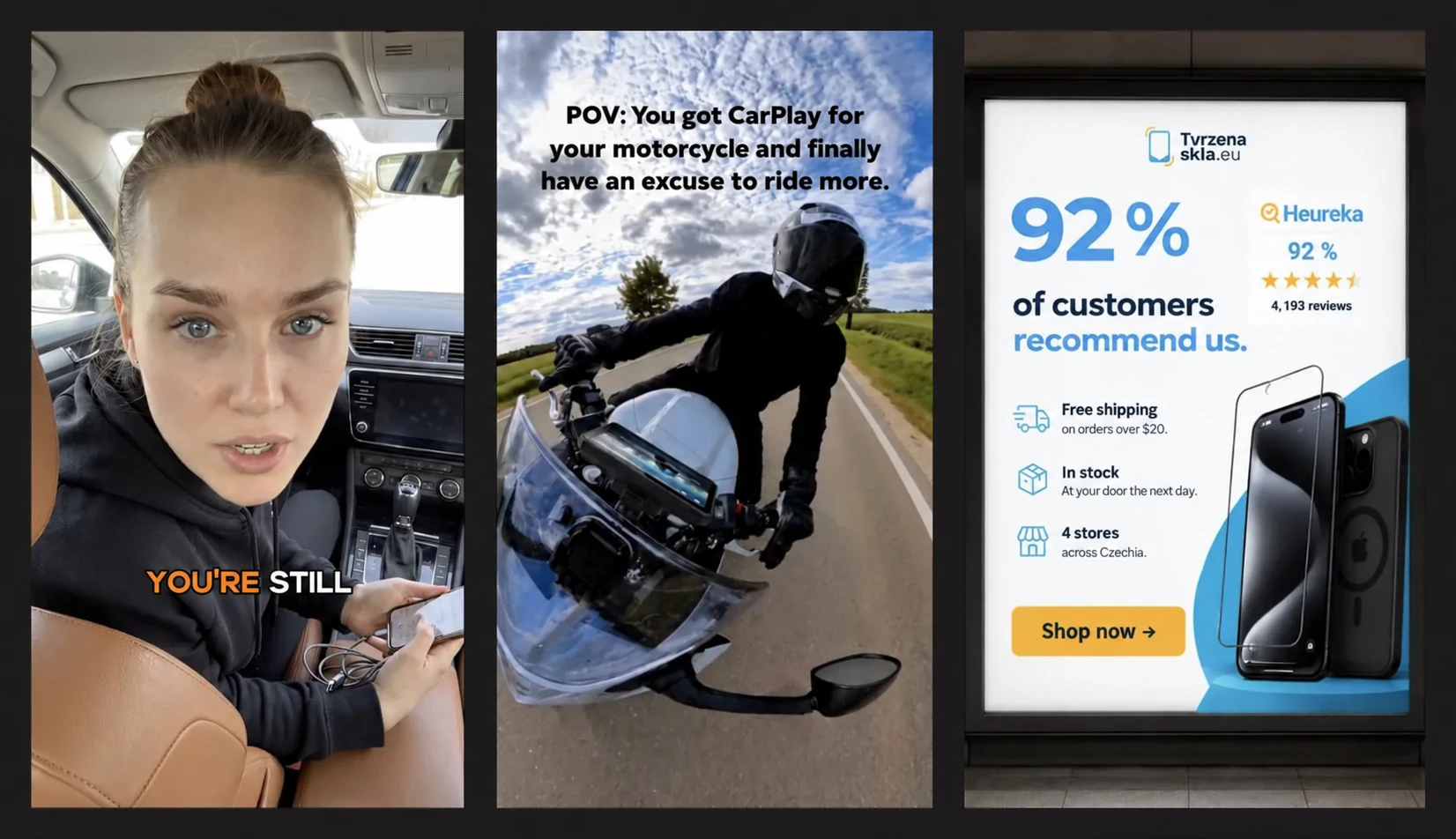
In June, the best new video delivered 45–60% higher return on ad spend (ROAS) than the account’s previous top-performing dynamic ad set. The range reflects two runs of the same video in different ad sets. Separately, the new videos achieved up to three times the click-through rate (CTR) of the account average.
June: more than a fifth above expected revenue
We did not pull the expectation out of thin air: we built it on this year’s trend, last year’s and the year before’s, and on how the April → May → June transition behaves historically. For good measure we had it computed by two independent forecasting models as well — Prophet and a regression model with trend and seasonality, both trained on three years of data through May. Both expected a “normal” June and agreed with our plan. Instead, store revenue finished roughly 22% above the expected level — outside the regression model’s 90% prediction interval.
Client CRM revenue, excluding VAT. The three comparisons use the same source as the chart. Historical analytics figures cross a cookie-consent change in April 2025 and are not comparable.
2026 revenue by month · actual against the models’ expectation
Client CRM revenue, excluding VAT · indexed, January = 100
Within the same 2026 analytics setup, revenue attributed to paid social rose 4.7× month over month and its share of store revenue jumped from a few percent to several times that — and this in last-click attribution, which tends to take credit away from Meta rather than give it. At the same time the channels that close purchases grew by roughly 10–15%, consistent with video creating demand that other channels help convert.
The strongest evidence came from the client, though: the products the new creative pointed at were selling exclusively through Meta — no other channel was pushing them. And they sold well enough that some went out of stock and were briefly unavailable.
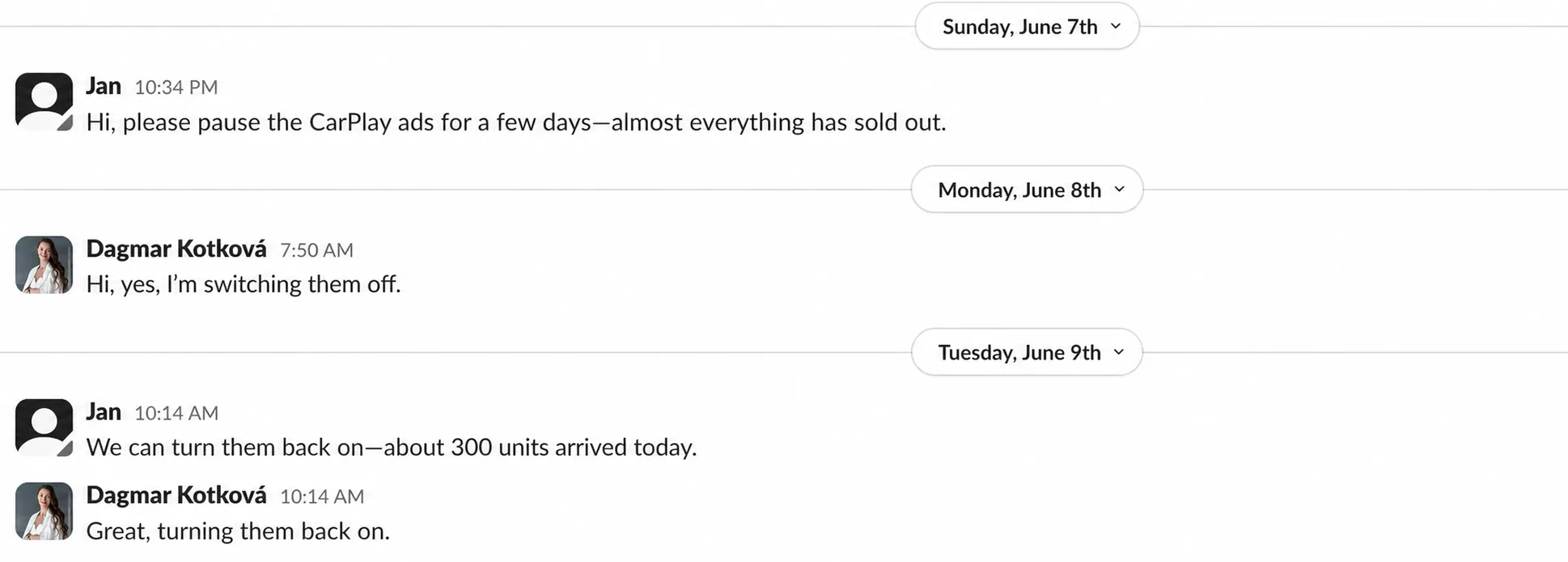

These are observed results, not a controlled experiment. Google Ads remained the main sales channel, and its spend also increased in the second half of June. Revenue was already growing earlier in the month, especially for products featured in the new videos. That supports the case for Meta’s contribution, but does not isolate its effect from inventory, other channels, or market conditions. A forecast comparison estimates what might otherwise have happened; it does not prove that all additional sales came from the videos.
In the client’s own words
These messages are translated from Czech and presented in the order they arrived. For context, in the spring, after two years of working together, winding Meta down to a seasonal-only channel was on the table. And then it started to turn:
“We were at Google in Prague today. The guy there was showing how everyone is doing AI now. I think this direction could work.”
“OK, agreed. But let’s test it really intensively in June and then evaluate it.”
“Dude, this is great. Let’s go in this direction.”
“Hey, the new creative and that video are good. Three people I know have already messaged me saying they saw it and really liked it. And nobody even noticed it was AI.”

Client · Momanio
June 3 · a few days after launch · Translated from Czech
You know the rest from the previous section: a “suspiciously good” June, products selling out, and an August plan to take the same creative to the expansion markets. In three months, a conversation about winding the engagement down became a conversation about which market to expand into first.
What we take from this
Four things worth taking from this study, whether you run an ecommerce store or anything else.
A well-managed account gives new creative room to work
Two years of testing gave the account a solid base — value optimization, a consolidated structure, clean attribution. Without it, scaling would not have worked. But no further setting broke the ceiling. Creative did.
“Video works” is useless until you can afford enough attempts
Knowing the answer and being able to deliver it are different problems. AI reduced the cost and turnaround time of production. More attempts for the same money means a better chance of finding the winner while the season is still open.
Samples do not convince a client. A test in their own account does.
Skepticism about AI creative is reasonable and healthy. There is no point arguing it away in a presentation. Run the first videos alongside the live campaigns on a capped budget and let the data talk.
Dead ends are worth paying for
If we had never tried product sets, the feed, and cart optimization — and never killed them — we would still believe the growth was hiding somewhere in the settings. Those tests helped us see that creative production was the next constraint to address.
July: a second month of growth
We waited for July before publishing to see whether the improvement would continue. Revenue rose 21% year over year, while May — the last month before the new creative — was down year over year.
In July the system ran exactly as it should: the June winner got several times the budget and held its performance, roughly twenty more new creatives went live alongside it, and paid social’s share of revenue doubled again — at unchanged overall efficiency. Models estimating revenue without the new creative suggest 18–28% additional revenue across the two months combined. These are modeled estimates, not separately tracked sales.
And honestly: one new creative sold below cost and was switched off, and on another we found a deployment error. That is what a system looks like too — not that mistakes stop happening, but that they show up in the data within days.

At the time of publication in August 2026, the next step was to test the approach in the other markets and improve the process from idea to launch. The results reported here cover the Czech market only.
Has campaign growth stalled?
We manage Meta Ads and produce AI video creative for ecommerce brands across international markets. We can review your account, explain what is limiting performance, and identify the next useful test.